

Estimated reading time: 5 minutes
Ambulatory Surgery Centers rely on contingent labor more today than ever before. To fill scheduling gaps and avoid the markup fees associated with Managed Service Providers (MSPs), many ASC administrators choose a direct vendor staffing model. This means your internal team contracts directly with five, ten, or even fifteen different staffing agencies to source per diem nurses and locum tenens.
On paper, bypassing the MSP fee looks like a smart way to protect your margins. In reality, the manual administrative burden of managing multiple agencies may wipe out those savings entirely.
When you factor in the hours spent chasing credentials, reconciling fragmented invoices, and broadcasting shifts via email, the direct vendor model is quietly draining your operational efficiency.
This administrative drag is exactly why we recently highlighted the missing staffing layer in your ASC software, because relying on clinical systems to manage complex vendor relationships is a losing battle.
The Illusion of Cost Savings in Direct Vendor Staffing Management
Most ASC administrators and Directors of Nursing (DONs) know exactly why they avoid external MSPs. You want direct relationships with preferred local agencies and you want to tightly control your premium labor spend.
But look closely at how your team actually executes this model.
Your DON is likely acting as a part-time staffing coordinator. Your billing department is manually cross-referencing paper timesheets against clinical logs. Your operations managers are tracking AAAHC compliance on a shared spreadsheet. You saved the 4% MSP fee, but you traded it for hidden administrative drag.
The 5 Hidden Costs of Manual Agency Management
Managing a roster of staffing agencies without centralized infrastructure creates friction at every stage of the procurement lifecycle. Here are the areas where the direct vendor staffing model costs you the most.
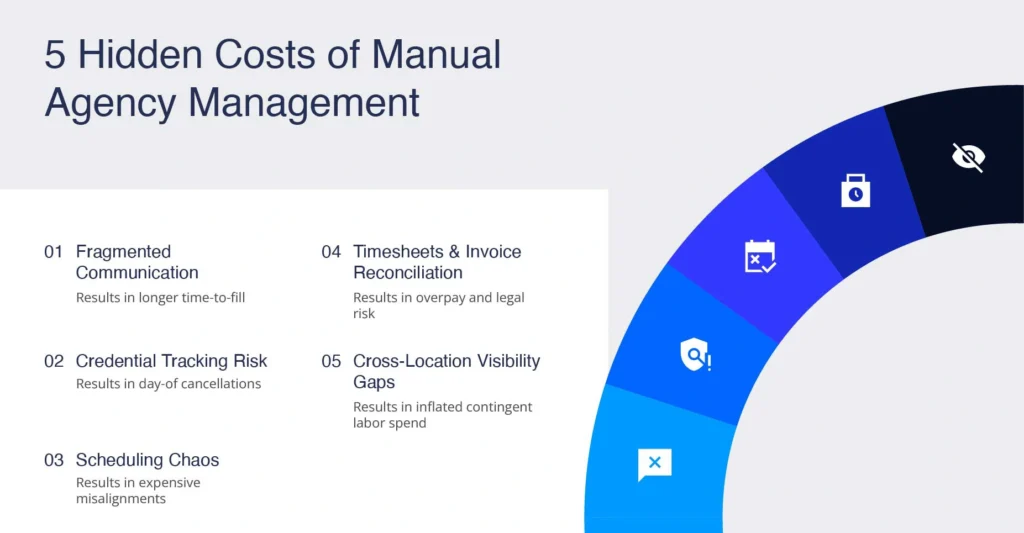
1. The Time Cost of Fragmented Communication
When a shift opens due to a sick call or a volume spike, your team has to reach out to multiple agencies individually. This means sending five different emails, making phone calls, and waiting for text messages to bounce back.
The Result: Your time-to-fill drastically increases. While your DON is waiting on agency responses and manually comparing candidate profiles, cases risk being delayed or rescheduled.
2. The Risk Cost of Manual Credential Tracking
Compliance is non-negotiable, but every agency sends credentials in a different format. Some use secure portals, while others email zipped PDFs. Your team is forced to download these files, upload them to internal folders, and track expiration dates manually to satisfy Joint Commission or AAAHC standards.
The Result: Human error leads to day-of-surgery cancellations. There is nothing more expensive than a scheduled procedure coming to a halt because a per diem surgical tech arrived but their BLS certification or state license was not verified in your system.
3. The Operational Cost of Scheduling Chaos
Surgical schedules change constantly due to case add-ons, surgeon block releases, and patient cancellations. In a direct vendor model, your clinical schedule and your agency schedule live in two different worlds. When an OR block shifts, your DON has to individually notify different agency coordinators and hope the message trickles down to the per diem staff in time.
The Result: Complete misalignment between OR needs and staff arrival times. You end up paying minimum-hour guarantees for canceled cases, double-booking roles by mistake, or leaving a surgeon waiting because an agency nurse was never notified of a start-time change.
4. The Margin Cost of Timesheet and Invoice Chaos
At the end of the week, your surgery center receives six different invoice formats from six different agencies. Your accounts payable team must reconcile these invoices against paper timesheets or clinical scheduling software that was never built to handle complex agency bill rates.
The Result: You inevitably overpay. Without a standardized system, it is nearly impossible to catch unapproved overtime, incorrect shift differentials, or billing discrepancies before the check is cut.
5. The Strategic Cost of Operational Blind Spots
If you operate a multi-site ASC group, the manual model completely breaks down. Facility A might be short-staffed while Facility B has excess agency coverage, but there is no centralized dashboard to show you that reality.
The Result: You have zero visibility into your total agency spend, no way to measure which vendor has the best fill rate, and no data to negotiate better rates during contract renewals.
Why You Need Vendor Management, Not Just Another Agency
In the ASC space, “vendor management” usually refers to supply chain software used by materials managers to track surgical implants and disposables. But when it comes to human capital, you need the exact same level of supply chain rigor.
You do not need to add another staffing agency to your roster. You need a Vendor Management System (VMS) built specifically for contingent labor.
The right software allows your ASC to “act as your own MSP.” You keep the direct relationships with your preferred staffing agencies and you avoid the third-party markup. Plus, all agency communications, credentialing, and billing runs through a single, automated portal.
Take Control of Your Margins with BlueSky
Transitioning away from a manual direct vendor staffing model requires infrastructure. BlueSky provides an end-to-end staffing platform designed to centralize your contingent labor management.
With BlueSky, your ASC can:
- Broadcast shifts instantly: Post an open shift once and route it automatically to your approved agency partners.
- Automate compliance: Block non-compliant staff from ever being scheduled with automated credential tracking and expiration alerts.
- Synchronize scheduling: Manage all internal and agency staff schedules in one unified calendar, ensuring real-time updates when case volumes shift.
- Standardize invoicing: Consolidate all agency billing into a single, unified format mapped directly to your approved rates and timesheets.
Stop letting manual administrative tasks eat your margins. Learn how BlueSky helps multi-site ASCs act as their own MSP. See it for yourself today.