
Estimated reading time: 5 minutes
If you operate a single ambulatory surgery center, managing a handful of local staffing agencies directly is usually a headache you can tolerate. But when your ASC group grows to three, five, or ten locations, that manual direct vendor model completely breaks down. (Spoiler: You can solve this with a centralized agency management model.)
At scale, relying on emails and spreadsheets to manage per diem nurses and locum tenens creates scattered communication, compliance risks, and opaque labor costs.
If you come from the hospital world, you know the traditional solution to this chaos: hiring an external Managed Service Provider (MSP). But in the margin-sensitive ASC environment, paying an outsourced company a 4% markup on every single shift is a non-starter. You also lose the ability to work with your favorite local boutique agencies.
Growing ASC groups are now adopting a smarter playbook. They are using specialized software infrastructure to centralize their agencies and “act as their own MSP,” gaining total operational control without paying the middleman fees.
The Hospital Playbook: Acting As Your Own MSP
To understand this shift, you have to look at why hospitals use MSPs in the first place. Health systems hire them to consolidate hundreds of agency contracts, standardize billing, and ensure every clinician has the right credentials before they walk in the door.
ASCs need that exact same level of organization to centralize agency management. They just do not want to outsource it.
“Acting as your own MSP” means your internal team keeps complete control over your staffing strategy. Your Directors of Nursing (DONs) and administrators still decide which local agencies to use. You still negotiate your own rates. But instead of every facility managing those vendors manually, you use a centralized software platform to automate the busywork.
The software handles the shift broadcasting, the credential verification, and the invoice consolidation. You get the organizational power of a hospital MSP while keeping your direct vendor savings.
Why Manual Agency Management Breaks at Scale
When multi-site ASC groups try to scale without centralized software, they run into a coordination crisis.
Different facility administrators start using different agencies. Accounts payable teams drown in conflicting invoice formats. Most dangerously, leadership loses the ability to see true labor costs. If your only metric is a massive monthly line item for “contract labor,” you cannot manage your operations strategically.
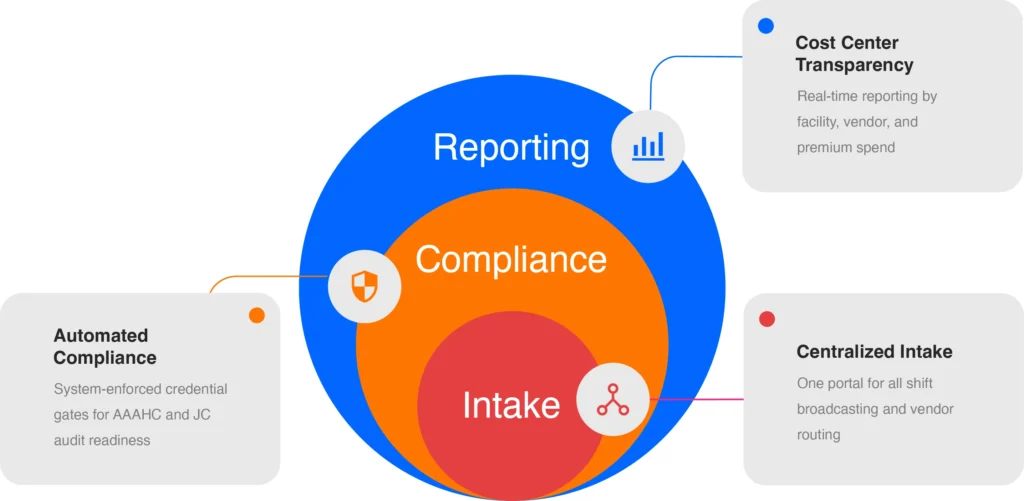
You cannot quickly answer which vendors are filling the most shifts, which locations are relying most heavily on premium labor, or where credential delays are causing day-of-surgery cancellations. You need cost-center transparency, and you cannot get that from a spreadsheet.
How to Build Your Internal Agency Management Program in 5 Steps
Transitioning from a manual, chaotic process to a centralized software model does not happen overnight. Here is the exact playbook growing ASC groups use to take control of their vendor management.
Step 1: Audit and Consolidate Your Current Vendors
Right now, your facility in one city might be paying $10 more per hour for the exact same agency nurse as your facility in another city. Before you implement software, audit your current vendor roster. Identify every staffing agency your facilities are using, compare their bill rates, and standardize your contracts. You will likely find that you can trim your roster down to a core group of high-performing partners.
Step 2: Implement Centralized Infrastructure
You cannot manage this transition on spreadsheets. You need a Vendor Management System (VMS) to act as your operational hub. This software becomes the single source of truth for your entire contingent labor program. It will handle the shift broadcasting, credential storage, and invoice consolidation across all your locations.
Step 3: Define Your Custom Vendor Routing Rules
Acting as your own MSP means you get to dictate how shifts are filled. Work with your software provider to build custom tiering rules. For example, you can set the system to automatically broadcast open shifts to your lowest-cost, most reliable local agencies first. If the shift remains unfilled after 24 hours, the system can automatically release it to secondary, higher-cost national agencies.
Step 4: Build a Universal Compliance Checklist
Stop letting individual facilities decide what paperwork is acceptable. Build a single, rigorous credentialing checklist within your new software platform based on Joint Commission or AAAHC requirements. The system must be configured to act as an automated gatekeeper, physically blocking agencies from submitting candidates who lack verified, up-to-date documentation.
Step 5: Mandate the “One-Channel” Rule
This is the hardest cultural shift, but the most important. You must stop individual DONs and administrators from texting their favorite agency recruiters on the side. Every single open shift, schedule change, and timesheet approval must flow through your centralized software portal. When you force 100% of the activity through the platform, you instantly unlock the real-time reporting and cost-center transparency you need to manage your margins.
The Software Infrastructure Built for the Job
You cannot centralize your agency management using an EHR add-on or a generic clinical scheduling tool. Those systems are not built to handle complex bill rates, agency contracts, and multi-vendor credentialing.
You need purpose-built staffing infrastructure. BlueSky is the exact software engine that allows healthcare organizations to act as their own MSPs. It is a centralized platform designed to give multi-site ASCs total visibility and control over their contingent workforce.
BlueSky is completely vendor neutral. It is not an agency, and it is not an outsourced MSP. It is the technology that allows your team to automate shift broadcasting, enforce audit-ready compliance, and unlock real-time financial reporting across every facility in your portfolio.
Ready to cut out the middleman and regain control of your contingent labor spend? See how BlueSky VMS helps growing ASC groups act as their own MSPs. Book a demo today.